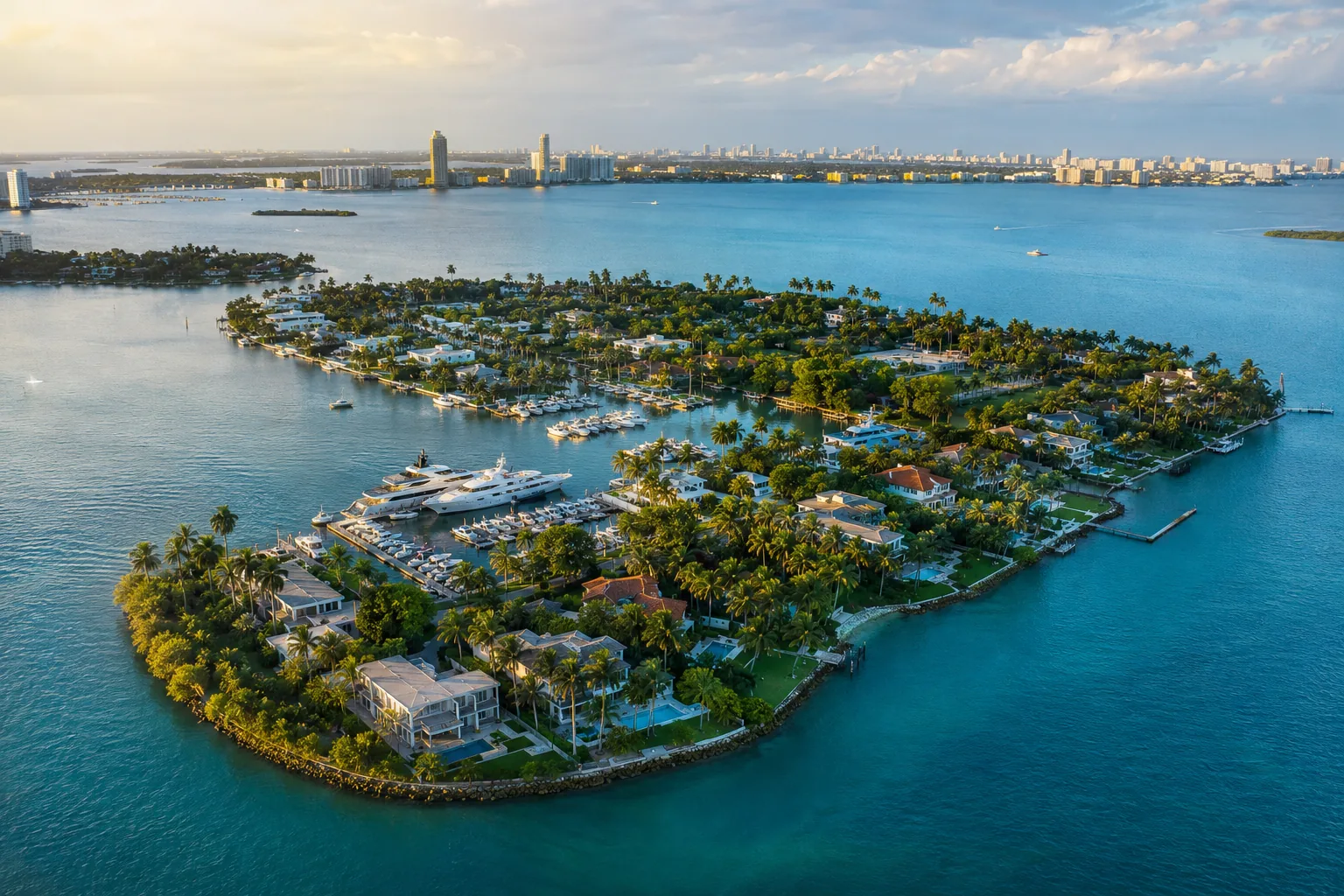
Miami's islands are frequently grouped together as a single category of trophy living, which obscures how genuinely different they are. Key Biscayne, Fisher Island, Indian Creek, and Star Island each sell a different version of the same idea, separation by water, and the buyer who understands the differences will not waste time on the wrong one.
Key Biscayne is the island that functions as a full community. It has schools, a real town, beaches, and a family-oriented residential culture, all reached by a single causeway that gives it separation without isolation. The buyer here is often a family that wants island life as a way of living rather than as a statement, and the market spans a wider range than the other islands, from substantial condominiums to oceanfront estates.
Fisher Island is the opposite proposition: an island reachable only by ferry or boat, with no public access, where the separation is the entire product. It functions as a private membership community as much as a residential address, and the buyer is paying for a degree of seclusion and service that simply cannot be obtained on the mainland at any price. Inventory is limited by definition, and the market behaves accordingly, quiet, discreet, and famously hard to enter.
Indian Creek and Star Island occupy the most rarefied end, the single-family estate islands where the unit of trade is the waterfront lot and the residence upon it. These are markets measured in a handful of transactions, where privacy is near-absolute and where the buyer is, almost always, someone for whom the purchase is one of the most discreet they will ever make. There is no public market here in any ordinary sense. There is a network, and access to it is the actual asset.
What the water buys, across all four, is a moat in the literal sense: a fixed limit on supply, a barrier to casual access, and a privacy that mainland security can only approximate. That moat is why island pricing tends to hold a premium across cycles and why the resale market, while thin, rarely disappoints a patient seller. Scarcity that is enforced by geography does not soften the way scarcity created by zoning can.
The practical counsel for an island buyer is to be honest about which kind of separation they actually want. Family community with a causeway is a different life from ferry-only seclusion, which is different again from a private estate island where neighbors are measured in the single digits. Each is legitimate. Each commands its premium for a specific reason. The error is buying the prestige of an island without first being sure you want the particular form of isolation that island enforces.