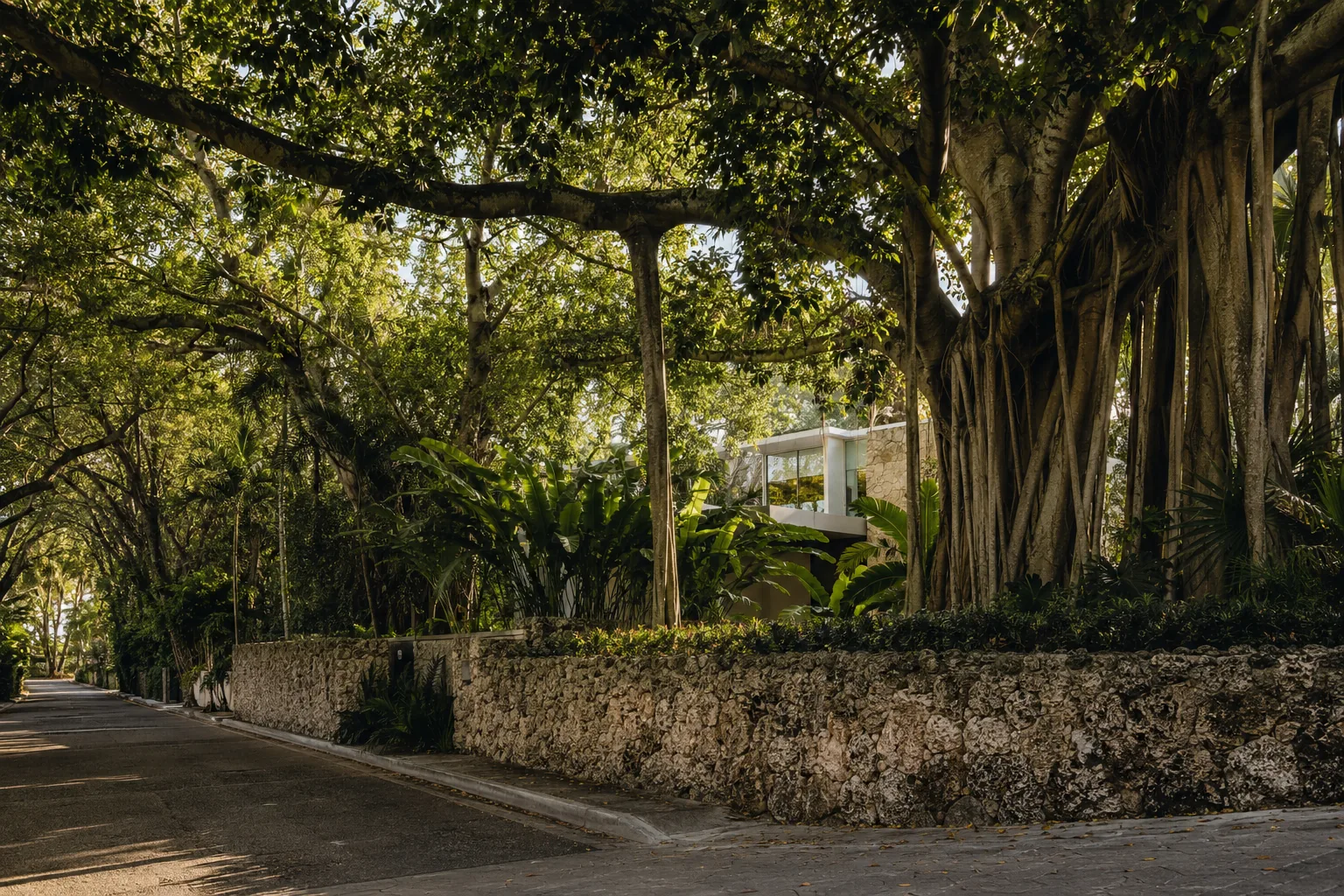
Twenty years ago, Coconut Grove was the quietly bohemian counterweight to the rest of Miami, a place that prized its tree canopy and its village scale and held a certain suspicion of the towers rising elsewhere. Two decades on, the Grove has changed more than its residents like to admit and less than its critics feared. The canopy is intact. The map underneath it has been redrawn.
The most visible change is at the waterfront and the village center, where a generation of design-forward low-rise residences arrived and reset the top of the market. These buildings did something the Grove had resisted: they brought genuine, serviced, contemporary luxury into a neighborhood that had previously offered character but rarely turn-key sophistication. The buyer who wanted the Grove's atmosphere without compromising on the finish of a Brickell or beach residence finally had somewhere to go.
Yet the defining asset of the Grove remains what it always was: the single-family home under old trees, on a real lot, within walking distance of the bay. This is the stock that holds the neighborhood's identity, and it has appreciated quietly and durably precisely because it cannot be replicated. You can build another tower. You cannot manufacture a hundred-year-old canopy or a street that has looked the same for generations. Scarcity here is literal.
What has not changed is the buyer's underlying motive. People who choose the Grove are, by and large, choosing against the obvious. They want shade over glare, scale over spectacle, and a sense of neighborhood over a sense of arrival. That has been true across the entire twenty years, through every shift in the rest of Miami, and it is the most reliable thing about the submarket.
For the buyer evaluating the Grove today, the practical distinction is between the new luxury product, which offers convenience and services and a known finish, and the heritage single-family stock, which offers irreplaceability and a longer-term store of value. Both are legitimate. They are simply different decisions, and the buyer who understands which one they are actually making is the buyer who will be satisfied in ten years. The Grove rewards that kind of clarity. It always has.