
Coral Gables
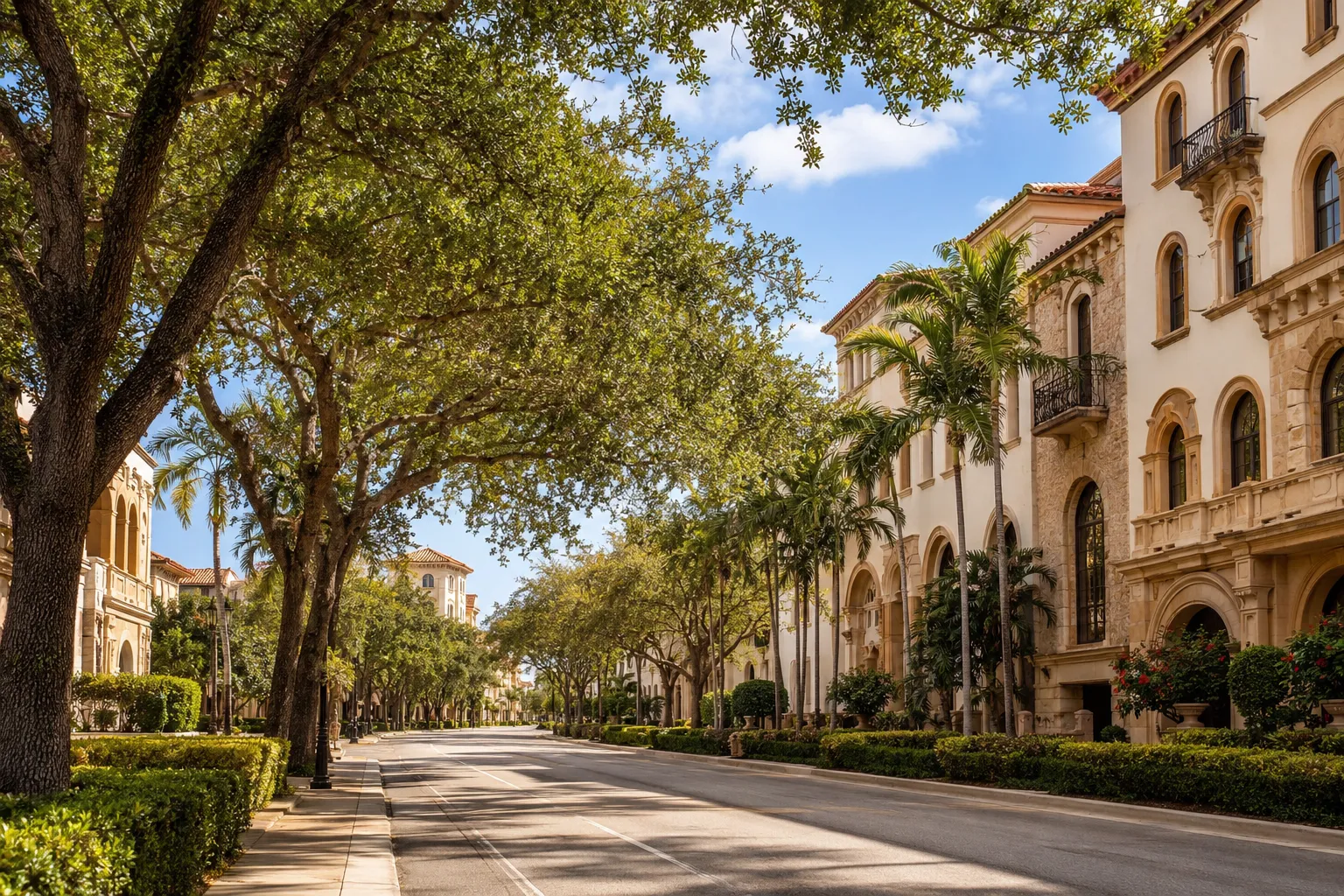
Miami's only fully master-planned city, a 1925 Mediterranean argument, kept.
Coral Gables was master-planned in the 1920s by George Merrick as a Mediterranean revival city. The plan was unusually thorough: uniform street widths, a tree canopy ordinance, building height restrictions, and a Mediterranean stylistic standard that the city has actively preserved for a century. The result is the only neighborhood in Miami where the architectural language of the 1920s is still the dominant language of new construction.
The Biltmore Hotel, the Venetian Pool, and the Country Club anchor the historic core. The University of Miami and Miracle Mile retail anchor the day-to-day. The single-family inventory within the canopy, spanning Old Cutler Road, Tahiti Beach, Cocoplum, and Snapper Creek, runs from $3M to $40M, with the deep-waterfront tier on Tahiti Beach and Old Cutler trading at the high end.
For the buyer who wants the architectural and cultural continuity of an older European city, and is willing to trade the Atlantic frontage for it, Coral Gables is structurally underrated and has been for years.
What defines it.
The only master-planned city in Miami-Dade. 1925 Mediterranean revival, preserved.
Biltmore Hotel, Venetian Pool, Country Club, University of Miami.
Single-family inventory dominated by 1920s and 1930s stock, often impeccably restored.
Enter Coral Gables.
Active addresses and private introductions in Coral Gables are handled personally by Mariana Niro.